Saturday, December 08, 2007

Muestra Reservada

Omar G. pointed me to two rare records he recently obtained. Both are Odeon records, with a paper label and the name of the catalogue number, tune and artist written with pen.

O. ALEMAN INTERPRETA

( = Oscar Alemán y su Conjunto de Jazz): Mario Felix cl, Carlin Traversa v, Julio Graña v, Raúl Casanova v, Alberto A. Barbera p, Oscar Alemán g vo, Alberto Ramos g, Aldo “Néne” Nicolini b, Arminio Raguza dm

Recorded Buenos Aires, 16 May 1951
GRAB. Nº 18012 RIO SWANEE TITULO (GRAB = Grabación (Recording))
Odeon Muestra Reservada

This record was also released as (78rpm) Odeon 55240/ Odeon 74047 / (33rpm) Odeon LDS161 / EMI 542030 / EMI MFP 4645 / MFP 42018 / (cd) ACOUSTIC DISC ACD-29 / Virgiljazz CD 121/ PAGINA12 1516 CD2

O. ALEMAN INTERPRETA

( = Oscar Alemán y su Conjunto de Jazz): Mario Felix cl, Carlin Traversa v, Julio Graña v, Raúl Casanova v, Alberto A. Barbera p, Oscar Alemán g vo, Alberto Ramos g, Aldo “Néne” Nicolini b, Arminio Raguza dm

Recorded Buenos Aires, 16 May 1951
GRAB. Nº 18013 CABEZA HINCHADA TITULO
(GRAB. = Grabación ( Recording ))
Odeon Muestra Reservada

This record was also released as (78rpm) Odeon 55240 / Odeon 74047 / 33rpm) Odeon LDS120/ EMI 541686 / (cd) PAGINA/12 vol 2 / Virgiljazz CD 121

This sample record contains, probably, the take that was reserved as the first choice to issue.

Thanks Omar G. for sharing these labels with us. Thanks Luis C. for your help.

Keep swinging

Hans Koert

keepswinging@live.nl


Monday, December 03, 2007

The Copenhagen December 1938 Recordings

In January 2004 I wrote a short article on Oscar Alemán in Scandinavia, the following entry is excerpts of this article, which is previously unpublished. Hans Koert's article on Oscar Alemán in Copenhagen from September 2005 has additional info regarding the subject discussed here. I encourage readers to consult Hans' article for further info and details, the article is available online clicking here
---
Svend Asmussen estimated Alemán very high as a guitarplayer and as a person, and Asmussen was the key person, who took the initiative to organize a recording session featuring Alemán during the 1938 Josephine Baker tour of Scandinavia.

A Jam Session with members of Asmussen’s and Leo Mathisen’s regular bands featuring drummer Bibi Miranda and Oscar Alemán from the Baker staff was scheduled at Dec. 5. The recording took place at HMV’s studio in Copenhagen, and regarding the circumstances of the recording session Svend Asmussen has told that, “Nobody was on top form, as the session was scheduled at 12 o’clock in the morning, which is the same as deep night, when you are in the night club entertainment business".


JAM SESSION: Svend Asmussen (v), Henry Hagemann (ts, cl), Oscar Alemán (solo g), Helge Jacobsen (g), Alfred Rasmussen (b), Bibi Miranda (dm). Copenhagen, 5. December 1938.


OCS 1083-2 Sweet Sue HMV X 6212

OCS 1084-2 Limehouse Blues HMV X 6212


The record of course was a 78’ rpm. and it sold 565 copies (!). The low sales rate, however, does not reveal the very high standard of the recorded music, indeed. Many jazz critics estimate this specific record as one of the best by Asmussen – and by Alemán, even so. Norwegian jazz critic and writer, Jan Evensmo writes a comment on the recording regarding Alemán’s participation:

"This jam features Oscar Aleman at his very best, and the record may be considered one of the great guitar records of the late thirties. “Sweet Sue” is a masterpiece without any doubt and his 32 bars’ solo is one of the most beautiful and personal I know. It is perfect in its melodic construction, made as one complete piece, almost as one long phrase. The intro, the brief solo and the coda are equally impressive, and this record alone is enough to give eternal fame to Aleman. “Limehouse Blues” is also an extremely important piece. From the very beginning he creates an atmosphere together with Hagemann’s clarinet. His solo starts, quite surprising when you hear it for the first time, with a typical Aleman device, a quickly repeated tone against the rhythm. And then he takes off with no technical problems, the result is a very fine solo. Note particularly the opening phrase of the bridge. However, the highlight is the 8 bars which conclude the record. Unforgetable!”

No doubt Mr. Evensmo rates the Jam Session recording of 1938 with Alemán very high! He also writes about the recording of the two guitar solos by Alemán which was done at the same date. The sales rate of this recording ran even lower than the Jam Session – only 91 copies (!) were actually sold.

OSCAR ALEMAN (g solo), Copenhagen 5. December 1938


OCS 1085-3 Nobody’s Sweetheart HMV X 6213

OCS 1086-1 Whispering HMV X 6213

Jan Evensmo writes regarding these two solos:

“These guitar soli are formidable contrasts to the two preceding sides recorded on the same day. Being completely unaccompanied they are not jazz records in the ordinary sense but rather a guitar virtuoso playing some popular songs. They do not contain the masterly economic solo lines of “Sweet Sue”, nor the overwhelming swing. Instead they contain all the tricks of a master of the Spanish guitar, and every chorus is different with delightful details. They do not give so much the picture of Aleman the jazz musician as of Aleman the guitarist. Together these pictures are very important and show a very interesting personality, which is not by far “discovered” by many otherwise well informed jazz and guitar enthusiasts.”

Evensmo stresses the fact that Alemán is alone with his guitar in the setup of the recording – the reading of the two tunes is in fact guitar soli without other accompanying musicians besides the guitarist himself. This makes the recording rather unique, as it was not usual at all at the time of the recording to issue solo guitar records, at least not featuring a guitarist playing popular repertoire favoured by jazz musicians and their audience. This may perhaps also explain, why the actual record only sold 91 copies – the potential market simply was not prepared for and used to a solo guitar record of popular songs, at least not without a singer to interpretate the lyrics. Nevertheless, the record is outstanding in Alemán’s recording career, too, as he had not been recording solo before, and the next time he did solo guitar recordings was not untill 1972 in his homeland, Argentina.

Another aspect concerning the recorded guitar solos is highlightet in the quoted comments above. Evensmo states that the music is not jazz in the ordinary sense and that the record is lacking the overwhelming swing compared to the Jam Session recording of “Sweet Sue”. Instead he stresses Alemán’s mastering of the technique usually used by guitarists playing the Spanish guitar, which most often means classically trained guitarists. This is crucial to understanding and appreciating Alemán’s efforts as a guitarplayer on this particular recording. However, most interesting and surprising is in fact, that Alemán was not a classically trained guitarist! He was self taught, an autodidact, and he could not read written music, either, which usually is demanded of classically trained musicians playing an instrument alone or in ensemble. Thus, the 1938 solo guitar recordings by Alemán are otherwise unique, too.

Regarding Alemán’s guitar technique this short survey is not the spot for an analysis in detail. Enough to tell is that he uses his fingers on both hands when playing, the right hand technique is as crucial as the one by the left hand. This style of playing is often called fingerpicking guitar style, and a master of this style can manage to play melody, chords and rhythm at the same time by alternating the approach of the right hand fingers to the strings. Alemán uses the fingerpicking technique throughout on both recorded tunes, and no one before him had done the same in a jazz recording setting, even though early masters of the jazz guitar, i.e. Lonnie Johnson and Eddie Lang, had applied a right hand fingerpicking teqhnique on some of their recordings, too. Compared to these early efforts, however, Aleman’s definitely are quite different and may perhaps be best explained in connection with the musical heritage of Latin America guitar tradition, which Alemán brought with him as a crucial experience even before performing as an entertainer, musician and guitar virtuoso in various settings around Europe on tour with the Josephine Baker company.
---

Sources:

Jan Evensmo: The Guitars of Charlie Christian, Robert Normann, Oscar Aleman (in Europe). Oslo, c.1976 (Jazz Solograhy Series, vol.4)

Erik Wiedemann: Jazz i Danmark – i tyverne, trediverne og fyrrene, vol. 1-3 (Copenhagen,
1982); vol. 1, p. 422, note 188/06; vol. 2, p. 79, p. 84, vol. 2, p. 98, vol. 2, p. 143

Hans Koert: Oscar Alemán In Copenhagen (2005)

---

Jo


Monday, October 22, 2007

Oscar Aleman remembered

( Traduzca este texto al español)

This time a personal remembrance to Oscar Aleman by guest contributor Fernando Gelbard from Buenos Aires, Argentina.


It was February 1949, I was 9 years old and was spending my summer vacations at my grandparent's home in Tucuman, Argentina.
My uncle Enrique Haskel was a member of the board at the Atletico Tucuman football club. They were powerful and like many other institutions and organized Bailes de Carnaval (Carnival -gigantic- Dance Events).


It has been a custom in Argentina for the football clubs to organize Carnaval dance events in which at least one "orquesta tipica" (tango group) and a "jazz" (a jazz band or non-tango group) where hired to perform every night for the people to dance while having lots of beers, wine and some snacks. Usually people were standing and there may be chairs for the ladies and their chaperons (usually their mothers). One would approach a lady and ask her: Shall we dance?
For those Carnavales in Tucuman, 1948, the Club Atletico Tucuman hired the hottest jazz group in Argentina...Oscar Aleman y su Conjunto de Swing. They signed an 80,000 pesos deal with Oscar Aleman, which was a big sum of money for the time; you could literally buy a house with that sum. My uncle took me to the bailes (dance parties). Being a nice quiet boy, I watched the people dance while sipping an orange Crush or a Bidu (an imitation of Coca Cola) and listened and watched this little dark man playing wonders with his guitar, even with the guitar in his back and still playing notes.

I remember a violin player (without doubts Hernan Oliva) and two more guitars, bass and drums. I didn't know what jazz was at the time, but I was a very musical kid, so I enjoyed every minute of it. My uncle Enrique, who didn't drink alcohol, took me every night to the club and back home in a taxi. The dance area and the stage were big, probably thousands of people. In later years as a musician I did work the carnavales and was able to have a sense of the size of the clubs (in Buenos Aires) and their audiences although jazz had already disappeared almost completely.

I do remember one night at the Club Bomberos de Etchenagucia (Etchenagucia Fireman’s Club) in which I played with some lousy band and opposite us performed The Georgians band, a who's who in the hot jazz scene at the time (1957) with musicians like Roberto “El Gordo”, “Fats” Fernandez, Nestor Astarita and others. In later years, I owned Estudios ION (ION Recording Studios) and I met again Oscar Aleman, who recorded several albums for the Redondel Label. Oscar didn't want to use headphones or record on playback, but those inconveniences where overcame and several superb albums saw the light. ION recorded many historical figures, among them Astor Piazzola, Enrique Villegas, Chivo Borraro and others. Oscar Aleman will be always in my mind and heart as a pure creator, a generator of swing and a true super star.

Fernando Gelbard (Buenos Aires - October 2007)


This contribution has also been posted in English, Dutch and Spanish at the Oscar Aleman web log.
Thanks, Fernando, for this great contribution !!
If you have a subject that should be discussed here and you love to share it with the visitors of this blog please conctact me ( keepswinging@live.nl ). Maybe you're the next guest contributor.

Español ( To the English translation )

En febrero de 1949, yo tenia 9 anos y estaba pasando mis vacaciones veraniegas en la casa de mis abuelos en Tucuman.
Mi tío Enrique Haskel era miembro de la comisión directiva del Club Atlético Tucuman.
Era un club poderoso y como otras instituciones similares, organizaba bailes de Carnaval.
Era una tradición argentina que los clubes de fútbol y otros clubes deportivos y sociales organizen bailes de Carnaval en los cuales por lo menos una orquesta típica y una “jazz” (así llamadas todas las orquestas o conjuntos que no sean típicos, o sea de tango).


En esos bailes las orquestas actuaban (por ahí un termino mas adecuado que “tocaban”) para que la gente escuche y baile, mientras consumían mucha cerveza, vino, whisky y snacks.
Usualmente, los concurrentes estaban parados y en muchos bailes había sillas para las damas y sus chaperones, en general las madres. Uno se acercaba a una dama y le preguntaba “bailamos”?


Para esos Carnavales en 1949, el Club Atlético Tucuman contrato a la “orquesta” de jazz mas famosa del momento: “Oscar Alemán y su Conjunto de Swing”. Firmaron un contrato por 80,000 pesos con Oscar Alemán. En ese momento era una gran suma de dinero, que alcanzaba para comprar una casa!.
Mi tío me llevo a los bailes y yo que era un chico obediente, miraba bailar a la gente mientras tomaba una naranja Crush o una Bidu (una imitación de Coca Cola de esa época). Escuchaba y observaba a ese hombrecito oscuro tocando maravillas con su guitarra, inclusive con la guitarra alto en su espalda haciendo notas.
Me acuerdo del violinista de la orquesta (sin dudas Hernan Oliva), dos guitarristas mas, bajo y batería. Yo no sabia lo que era “jazz” en esa época pero era un chico muy musical y disfrute cada minuto. Mi tío Enrique, quien no bebía alcohol, me llevo cada noche al club y de vuelta a la casa en un taxi.
La pista de baile y el escenario eran grandes y cabían probablemente miles de personas.
En anos sucesivos como músico yo trabaje durante los Carnavales y tuve la oportunidad de darme cuenta del tamaño de los clubes (en Buenos Aires) y de sus audiencias aunque para esa época el jazz ya había desaparecido casi del todo en esos eventos.

Me acuerdo de una noche en 1957 en los Carnavales eb el Club Bomberos de Etchenagucia en los alrededores de Buenos Aires, en la cual yo toque con un conjunto de pelagatos. La otra orquesta eran Los Georgians, la sensacional banda de hot jazz en la cual tocaban un “quien es quien” del hot jazz argentino en 1957, entre ellos Roberto “El Gordo” “Fats” Fernandez, Nestor Astarita y otros.
En años sucesivos, fui propietario de Estudios (de grabación) ION en Buenos Aires.
Me reencontré con Oscar Alemán, quien grabo varios LP para el sello Redondel. Oscar no quería usar audifonos o grabar en playback, pero esos inconvenientes fueron superados y varios discos (LP) sensacionales vieron la luz. En ION grabaron muchas figuras históricas entre ellos, Astor Piazzola, Enrique Villegas, Chivo Borraro y otros. Oscar Alemán estará siempre en mi recuerdo como un creador puro y un generador de swing, un verdadero súper star.

Fernando Gelbard (Buenos Aires - October 2007)


Fernando, por esta gran contribución.

Keep swinging

Sunday, October 14, 2007

Some Of These Days ...

Dear Friends,

I'm writing you this small message from my exile, the Dusty Groves Departement of Jazz Guitar Heaven. I have now waited 27 years to communicate directly with your side of God's universe, because I knew only few would be listening to my message. Most people, who knew me and cared, when I was alive and visible in your dimension, have left and come over, I meet some of them from time to time when walking the clouds to get new strings for my new custom built guitar (- light as a feather to wear and heavenly to play!).

The reason I am writing you this is that I am concerned about my legacy to the world - not that it meant to be big business when I was still alive in your dimension. However, the recordings I did are worth remembering and preserving for historic reasons - I was a part of the story of jazz outside the US during the 30s, 40s, 50s, 60s and 70s. From time to time critics have mentioned me and a few recordings made in Europe during the 1930s in a footnote while praising my great friend in Paris, the immortal Django. That's ok, Django was a great guitarist and a marvellous friend - always willing to share his ideas, stories and meals. When I left Europe early 1940, Django was one of the friends I made over there I missed the most. Another friend I made in 1938 was Svend Asmussen, the great Danish violin player - I still have his humour, great sense of rhythm and arrangements in mind, and I remember while leaving Europe behind aboard the ship that brought me back to Argentina a decision to make a band featuring musicians that would be able to maintain and actually perform the ideas first presented to me by Django and Svend. I had success with my two quintets in the 40s, mainly because I followed these ideas by my great European friends, I still think. Most of the 48 recordings I made with the quintets are still available, preserved on CD and issued by both American and Argentine companies, great!

The 50s were years of success with my Orquesta de Jazz, both at Radio Belgrano and in live-performances fronting an enthusiastic audience in dance halls here and there. Most of the 60 recordings made with this combination for Odeon are preserved on CDs too, and document the ideas I had developed after listening to records by great American bands like Jimmie Lunceford - and outside jazz, the Spade Cooley Western Swing congregation (- Spade probably gave me the idea of having three violins playing in unison while backing my solos). I was also deeply inspired by Brazilian music during this period, which had a certain impact on the recorded repertoire and the ideas I tried to demonstrate in my guitar playing. However, this part of my recorded output seems to be overlooked by most critics who have commented on my music, a pity. I also made a live-recording together with Hérnan Oliva in 1954 during a concert at the famous Hot Club de Buenos Aires - the only time after our break in 1943 when our tempers didn't interfere and made a riot. It's a shame that the preserved three recorded tunes from this event haven't been re-issued on a cd, another historic document that ought to be available for a new generation interested in my legacy.

The 60s brought only few issued recordings mainly due to the fact that I had retired from the music scene and didn't have a contract with a record company, The reason for my retirement was a decision to slow down a tiresome career as an entertaining artist having to be on top of things day after day, during long night performances at a club or touring in and out of town. Moreover, my health was suffering from overwork, so I had to find a new way of earning my bread. I took in students of guitar to share my conception of guitarplaying, earned only little, but survived by giving guest performances at radio and in concert from time to time together with available musicians. I most often played in a quintet setting, named Cinco Caballeros for the occasion - some of the recordings we did for radio and in studio have been issued on vinyl and cd, but most of the live-performances we did never were released on records. Collectors of my recorded legacy, however, have preserved a great part of my live-performances at radio on tapes. Also this part of my story ought to be documented on cd by a company who would take care of these recordings in collaboration with the true collectors of my recorded legacy.

I was 're-discovered' by the public in the 70s and back on stage, recording and making appearances at various club dates in and out of town. The reason for my 're-discovery' may be the fact that I met again with Duke Ellington in 1968 during his tour of South America. When arriving by plane to Buenos Aires, first thing the Duke would ask was: "Where is Oscar? Bring me Oscar!". Luckily, his Argentine manager of the tour knew me and had me re-united with my old friend from Paris. We were both invited as guests at the American embassy and had a great time together with his bandmates, remenising old days and jamming till late hours. This event was headlined in some tabloids and suddenly my name was on everyone's tongue in music business. Until this meeting with the Duke I had been out of vogue for a decade, music taste had changed in the general public - rock'n'roll was the big thing and a business for sound investment. I didn't like rock'n'roll, but I payed my due to this music by recording a version of "Rock Around the Clock" late 50s. Anyway, as mentioned, the 70s meant my come-back in the spotlight. I loved it and enjoyed recording and performing again. The recordings made for Redondel in '72, '73 and '74 luckily are preserved on cd by now, and so are the trio-recordings I made for another company in '75. However, also from this period careful collectors of my legacy have preserved live-recordings on tape that ought to be issued in a proper way by a record company.

Silence is golden, they say, so now I'll keep quiet. An angel is waiting for me to contribute a solo stament of an old favorite of mine - "Some Of These Days" by Shelton Brooks.

Yours sincerely,

O.A.

Thursday, October 11, 2007

Hot Club de Boedo

One of the most active groups in playing the music of Oscar Aleman in Buenos Aires and surroundings seems to be the Hot Club de Boedo. These four active musicians are Waldo Fonseca at the solo guitar, Martin Lopez Goitia on the rhythm guitar, Heldo Fonseca clarinet and Julian Pierangeli at the bass.
They play in the style of the Hot Club de France, in Argentina represented by the legendary group of Oscar Alemán y su Quinteto de Swing, that featured Oscar Aleman on the guitar, Hernan Oliva on the violin, Dario Quaglia rhythm guitar, Andres Alvarez bass and Ramon M. Caravaca drums. This famous group played in the Hot Club style and made 5 records for Odeon Argentina in 1941 and 1942 before Hernan Oliva left the band. These two men: Oscar Aleman and Hernan Oliva were a great couple in music, but had strong ambivalent characters which caused a break off.

This band wants to play tribute to the three legendary Argentine musicians Oscar Aleman, Hernan Oliva and Eduardo Ravera. On Thursday the 14th of October 2007 they will give a concert at the Salón de la Unión Vecinal Liniers Sud, in Buenos Aires to remember the day that Oscar Aleman passed away 27 years ago. Special guest will be Guillermo Lancelotti Izquierdo, a trumpet player.


This summer the band gave some concerts in honor of Hernan Oliva and I found some fragments from a double concert they gave with the Ensamble Typhoon de la Escuela de Oficios Musicales which is directed by Heldo Fonseca, the clarinet player of The Hot Club de Boedo. I love to share with you two fragments by the Hot Club de Boedo, playing some tunes:

Rosa Madreselva ( Honeysuckle Rose)

Diga Diga Doo


The Typhoon Ensemble of the School of Music plays a very basic version of Ritmo Loco ( Crazy Rhythm ) and it is good to learn that these young people are enjoying playing this great music.


Please visit the Hot Club de Boedo web log.
This contribution will also be posted at the Oscar Aleman Web Log

Keep swinging

Hans Koert

keepswinging@live.nl

Friday, August 24, 2007

Trio Victor 1928-29

Recently I bought the shown cd-compilation, "El Violin Major del Tango 1928-1943" (el bandoneón, EBCD 94, iss. 1998) containing 20 tracks featuring violinist Elvino Vardaro (1905-1971) in various settings, a splendid career portrait in music of this great musician. I was anxious to learn more about Vardaro and his role in the field of Argentine tango, and from my interest in Oscar Alemán I was especially keen on knowing more about their co-oporation in the Trio Victor 1928-29 together with Gastón Bueno Lobo.

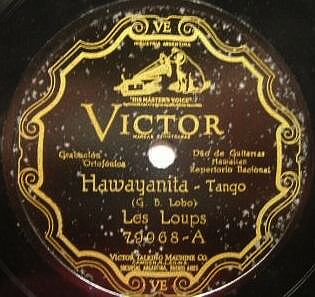
The inserted notes of the cd have an extensive career profile of Elvino Vardaro by Roberto Daus, but here it is only mentioned that Vardaro joined the Victor label in 1925 as the first violinist of the famous Orquesta Tipíca Victor, adding: "Vardaro was always busy, yet he still found time to head the Trio Victor, alongside guitarists Oscar Alemán and Gastón Bueno Lobo (Vardaro had previously worked in a trio of same name and different lineup, which featured Ciríaco Ortiz and pianist Eduardo "Chon" Pereyra)". From this info I concluded that the formation of the Trio Victor may have been arranged by the musical direction of the company as a way to promote certain musicians in the stable at Victor by giving them the opportunity to record as a soloist in a smaller ensemble than the usual orquestra. Alemán and Lobo had joined the Victor company in 1927 and started recording as Les Loups duo in December 1927 - no doubt, it would be an obvious commercial benefit and a publicity tool to take advantage of both Les Loups' and Vardaro's previous success with the public by bringing them together in a trio setting.

From the online discography of Oscar Alemán we know that Vardaro and Les Loups recorded together as Trio Victor in September 1928 and January 1929. The first recording took place c.26 Sept 1928 and was released on a 78 rpm disc (Victor 80967) featuring the tango "EL PRESUMIDO" by A. G. Villaldo - this is available on the shown cd. The flip-side of Victor 80967 was mislabeled as EL PRESUMIDO also, but according to available info it contained the waltz "Kiss Me Again" by Victor Herbert, probably recorded at the same session (- It is unknown if correct labeled copies of Victor 80967 do exist; if our readers have knowlegde about this issue, please let us know. Further, it would be great to have a scan of the correct label to be inserted in the online discography).
The next session by Trio Victor was scheduled at 14 Jan 1929 with the same lineup. Four sides were cut and released on two 78 rpm discs, Victor 47018 and Victor 47019. Victor 47018 has the fox-trot "MI NOVIO TRISTE" (My Melancholy Baby) by George A Norton & Ernio Burnett on the A- side and the waltz "UN BESO" composed by E. Vardaro on the B-side. Victor 47019 has the tango "PAGINA GRIS" by E. Cantore on one side and the fox-trot "JUANITA" by Gross on the other. The tango "PAGINA GRÍS" is on the shown cd-compilation, but I should like to hear the remaining sides from this session, too. The set-up of both the September 1928 and January 1929 sessions seems to have Elvino Vardaro in the soloist role, while Alemán and Lobo provide solid and elaborate accompaniment playing conventional guitars, adding rhythm and modulation statements to the contributions by Vardaro, who displays great virtuosity in his solo work.
There is some uncertainity regarding another recording session featuring Trio Victor from early 1929 or late 1928 released on Victor 47401. The personnel of this session haven't been confirmed yet. The A-side features the waltz "AMANTE SONADOR" (Dream Lover) by Victor Schertzinger, and the flip-side has the tango "RECONDITA" by Fausto Frontera. The recordings have been inserted in the online Alemán discography, as they most probably feature Vardaro, Alemán and Lobo in the same setup as with the remaining recordings made by this Trio Victor. However, we encourage readers with knowledge of this issue to supply further info.
The two recordings by Trio Victor on the above mentioned cd had me wishing that the remaining sides featuring Vardaro, Alemán and Lobo were available in my collection. Judging from the high level of performance by the trio on "EL PRESUMIDO" and "PAGINA GRÍS" it's a pity that these sides haven't been re-issued on a cd together with the remaining titles, documenting an important early part of the recorded legacy of Elvino Vardaro as well as Oscar Alemán.
Jo

Monday, July 23, 2007

New Info on Gaston Bueno Lobo

Just recently an interesting article on Gastón Bueno Lobo has been written in Portuguese and translated into English by Daniella Thompson at the Musica Brasiliensis website, also posted at her web log. The article is by Jorge Mello, a Brazilian researcher and musician; use the link above to read the article.
Earlier we have benefited from Mello's research in our published article on
Bueno Lobo
through the always helpful assistance of Daniella Thompson. The mentioned article by Jorge Mello, however, has some interesting new details regarding the bio of Bueno Lobo that should be added to the info already published at our website devoted to the subject.
Firstly, Jorge Mello has traced Bueno Lobo's year of birth - he was born 1891 in the city of Campos, Rio de Janeiro. However, no info about his family, relations and musical education has been available, nor has info about how long he lived in Campos.
Secondly, after much exertion Jorge Mello has managed to obtain a copy of Bueno Lobo’s official death certificate of June 3th, 1939 that states the cause of death as by ingestion of hydrochloric acid, presumably following a successfull suicidial attempt. This official statement of Lobo's death confirms the info given by Oscar Alemán, who mentioned in interviews that Lobo comitted suicide after returning to Brazil. However, the motive of Lobo's suicide is unknown and therefore still a subject open for speculations. Jorge Mello only touches indirectly on a possible motive by mentioning that Lobo's profession as a musician was declining after 1938, as his name appeared less and less frequently in the public media from around that time.

December 1927
Jorge Mello's article has more details about Bueno Lobo's career after the breakup of Les Loups in 1931 that will be quoted later in a revised issue of our website devoted to Lobo. Here it is sufficient mentioning that Bueno Lobo had returned to Brazil in 1932 and was already performing at radio in May of that year. Later the same year he participated as performer, accompanist, or composer in four records released by Odeon. The following years had more radio work and recordings, and judging from Mello's article Bueno Lobo's career was rather successful until 1938. However, as mentioned above, from around 1938-39 his name became less known in the public, which may be a motive of his suicide in 1939.
The biography and career of Gastón Bueno Lobo is interesting, from our point-of-view the interest was caught by the fact that parts of this story interfer with the bio and career of Oscar Alemán. Bueno Lobo is a crucial person in our knowledge of the formative years of Oscar Alemán, moreover Bueno Lobo seemed to have had a deep impact on the Psychological habitus of Oscar right up till the end of his life in 1980. However, these aspects will be discussed later in a revised article on Bueno Lobo.


This contribution will also be posted at the Keepswinging blogspot.

Jo

keepswinging@live.nl

Friday, July 20, 2007

Oscar Aleman Uñero

Oscar Aleman, the Argentine guitar player, has a special place in our hearts. With the Oscar Aleman web log and websites we hope to please the true admirers of his music. The Oscar Aleman Discography can be of help for record collectors if they are searching for a special recording. If we have news about Oscar Aleman you will read it here !!
I found an interesting picture that was titled Oscar Aleman - Uñero and it looks like a kind of ring. As my knowledge of the Spanish language is marginal I used the Español-Ingéls Diccionario and learned that the word Uñero has several meanings: 1. Whitlow. 2. Ingrowing toenail 3. Thumb notch. (How did he come up with such things? Find out yourself, I'd suggest !!). None of it seems suitable with this image. Even my always-on-the-other-side-of-the-line Argentine friend and oracle Luis didn't knew the word. The word Uñeta, however, means in Chile plectrum, so we decided that this ring should be the thumb plectrum of Oscar Aleman
To prove our point I enlarged part of the first image, where you can see Oscar Aleman playing his guitar. You can see the plectrum or Uñero around the thumb of his right hand.
This contribution was also posted as part of the Keep swinging web log.
Keep swinging
Hans Koert

Monday, July 16, 2007

Picture Homage to Oscar Alemán

I detected two recently uploaded videos at YouTube paying tribute to Oscar Alemán. The footage seems to be copied from Hernán Gaffet's documentary, 'Una Vida con Swing' (2002), but if you don't have access to this, here is an opportunity to have a view of some historical footage from the career of Oscar Alemán. Hope you to enjoy the two inserted videos!

The first video features the tune 'Bésame Mucho' by OA y su Cinco caballeros

The second video features the tune 'Temptation' by OA y su Quinteto de Swing


Jo

Tuesday, July 03, 2007

Hernán Oliva

When Oscar Alemán founded his first Quinteto de Swing late 1940, the ensemble consisted of Alemán as leader, arranger and solo guitarist, Dario "El Johnny" Quaglia on rhythm guitar, Andrés Alvarez on string bass, Ramon M. Caravaca on drums, and Guillermo Hernán Oliva on violin - the only other member of the group to be given solo space besides Oscar. Between November 1941 and November 1942 the quintet recorded 10 sides for Odeon, and if you listen carefully to the solo spots given to the violin, you will recognise a sound more like Joe Venuti than Stephane Grappelly and a talented improviser of the instrument. Hernán Oliva definitely belongs to the great swing violinists, and his recorded work with Alemán remains highlights of his career. Unfortunately, Oliva and Alemán stopped their cooporation in 1943 due to an incompatibility of temper, and they only recorded once more together in 1954 at a concert arranged by the Hot Club de Buenos Aires.
For details on the recordings of Alemán and Oliva, please consult the online Alemán discography, to be reached clicking here
Hernán Oliva was born 4 July 1913 in Valpariso, Chile. He was a self-taught musician and played popular music in Chile before moving in 1935 to Argentina. In Argentina he was a member of René Cospito's orchestra (1935-40), and during the following years he worked with Enrique Villegas (1940), Oscar Alemán (1940-43) and Ray Ventura's orchestra (1944). In 1944-46 he performed and recorded as a soloist in a group led by Louis Vola emulating the original QHCF. Later he worked as a sideman with Ahmed Ratip y sus Cotton Pickers (1947-55), as a leader (to 1967), and as a member of a swing quintet that made several recordings in the 1970s for the Redondel label. He continued to perform into the late 1980s.

The legacy of both Oscar Alemán and Hernán Oliva is kept well alive in Argentina. July 23th a homage to Hernán Oliva will be presented in Buenos Aires at a concert featuring contemporary groups that continue the great string swing tradition. Among the participating ensembles are Hot Club de Boedo, a group specializing in the musical legacy of Alemán and Oliva. Learn more about the mentioned homage concert at the blogspot of Hot Club de Boedo
To give you an impression of the music played by Hot Club de Boedo I insert a video performance from a concert in Buenos Aires 23 June this year. Enjoy "In The Mood"


Jo

This message is also posted at the keepswinging blogspot

Wednesday, June 13, 2007

Les Loups - La Cumparsita

Les Loups - Gastón Bueno Lobo & Oscar Alemán - recorded their version of the famous tango, 'La Cumparsita' by G.Matos Rodriguez, for the Victor company in August 1928. The recording was issued on a Victor 78 rpm (Victor 80936) with this title on side A (mx 44252-1) and on the flip side was a recording of the waltz 'Nadando en mar de rosas' (mx 44253-2), a composition by Les Loups. The recording is a true collectors item and has recently been on auction at eBay.

The tango 'La Cumparsita' is one of the most famous all-time favorites in this genre, you may learn more about the story of the composition clicking here

La Cumparsita has been around 90 years this year and is celebrated in Argentina and elsewhere - below I insert a video performance from a TV show by guitarist Cesar Amaro playing this famous piece.

Jo


Friday, May 11, 2007

La herencia musical de Oscar Aleman

Oscar Aleman in concert May 1974 = Oscar Aleman en el concierto el mayo de 1974


Oscar Aleman remembered in concert by the Hot Club de Boedo April 2007.

Oscar Aleman recordó en un concierto del Hot Club de Boedo el abril de 2007

Thanks Waldo Fonseca and the members from the Hot Club de Boedo, for keeping the music of Oscar Aleman alive.

¡Gracias, Waldo Fonseco y los muchachos de Hot Club de Boedo, por mantener la herencia musical de Oscar Aleman viva!!

Keep swinging

The Alemaniacs El Alemaniacs

( Joergen Larsen = Theo Van Der Graaff = Hans Koert )

Sunday, April 15, 2007

Masters of the Jazz Guitar

When you find a book in a book shop about a subject you are interested in, you have have some reference points in the index to check if the book is suitable for you. Some times ago I found the book Masters of Jazz Guitar by Charles Alexander at Donner's bookshop in Rotterdam and checked my reference point: Oscar Aleman. His name was on two pages. Of course I bought it.
From all the books about jazz in general and jazz guitar in particular (except my Oscar Aleman discography of course !!) this great book of Charles Alexander ( it has a bonus CD too - I'll discuss that item later) has the most lines dedicated to Oscar Aleman - 15. The information is to the point, but not complete. Alexander writes: He ( too ) did his share of backing work. for instance in live performances by American star Josephine Baker and in recording sessions, but his excellent jazz work was overshadowed by the reputation of Reinhardt, though Aleman allegedly considered himself the better player. Alexander refers to the fact that his first properly featured discs were made in Copenhagen with Svend Asmussen and solo and he mentions the recordings with his trio a year later too. The next info is about Aleman's career in Argentina and it seems as if Alexander only had limited access to original sources. Maybe he has heard the great Swing Guitar Masterpieces 2CD of Acoustic Disc, which only covers the years 1938 - 1957 as he doesn't refer to Oscar's later work. He concludes that Oscar made easy listening music in Argentina and recorded some standards with his Quinteto de Swing in the 1940s. I guess he never heard about Oscar's musical leagacy from the 1970s and 80s.

Charles Alexander has some more knowledge or more interest in Django Reinhardt. This great guitar player gets a complete chapter ( ca. 275 lines to compare with Oscar Aleman). He tells in a lot of words about his youth, about the terrible accident that caused the damage to his fingers and about the Quintet of the Hot Club du France. I was surprised to read about the relation between Django Reinhardt and Stephane Grappelli, who where on bad terms, although musically they seemed a harmonic duo. Alexanders gives a lot of information about Django Reinhardt during the German occupation and the years after that, when jazz music changed from swing to bebop. It was interested to learn how Django handled that period.
Later this week I hope to attend a lecture about Django Reinhardt from George Lankester, the Dutch authority on Django. I hope to learn more about this great French guitarist.
To be clear: Django was a great guitar player too, like Oscar Aleman, but the two are incomparable. The problem I have with Django Reinhardt and Oscar Aleman is that the balance in information between these two great guitar players is gone: We, the Alemaniacs, try to repair this lack of information so that jazz historians and guitar freaks can make up their minds.
For your entertainment: I posted three film fragments: two ( I found a small fragment Oscar playing the cavaquinho that wasn't posted before in our blogs) with Oscar Aleman in one of his films and the third fragment is the famous film with Django Reinhardt and Stephane Grappelli in duet (in color this time !!). Enjoy both fragments.


This contribution has also been posted at my Keep Swinging web log

Keep swinging

Hans Koert

Monday, April 02, 2007

Tengo Ritmo

Oscar Aleman y su Quinteto de Swing became a famous group in the 1940s after returning to Argentina from Europe that suffered from war. Their appearances in venues and on the radio made him very popular in the South America. In Europe and the USA we didn't knew about this popularity of Oscar Aleman due to the lack of commnunication thanks to the war. One of the tunes he made popular was Tengo Ritmo, written by George and Ira Gershwin and better known by their English title I Got Rhythm.

The group Hot Club de Boedo founded and directed by Waldo Fonseca plays these hits of Oscar Aleman in theatres and venue all over Buenos Aires to save Oscar's legacy and that of his violin player Guillermo Hernan Oliva for the young adults.

Waldo sent me a fragment of a performance in Buenos Aires where he and his group Hot Club de Boedo performs this Aleman classic tune. Waldo plays the guitar, Heldo Fonseca the clarinet, Martin Lopez on rhythm guitar and Julian Pierengeli bass guitar. The recording might have been made recently. Thanks for sharing Waldo.

This contribution is also posted at the Keep Swinging web log

Keep swinging

Hans Koert
keepswinging@live.nl

Fundado en Buenos Aires por el guitarrista Waldo Fonseca, tiene como premisa difundir el estilo de jazz que popularizaron en el Río de la Plata Oscar Alemán, Hernán Oliva y Eduardo Ravera. Desde el año 2000 viene organizando junto con organismos oficiales y privados conciertos, charlas y una intensa actividad docente con el objeto de preservar esta particular estética. Waldo Fonseca: guitarra y dirección; Heldo Fonseca:clarinete; Martín López Goitía:guitarra y Julián Pierángeli:contrabajo

Saturday, March 24, 2007

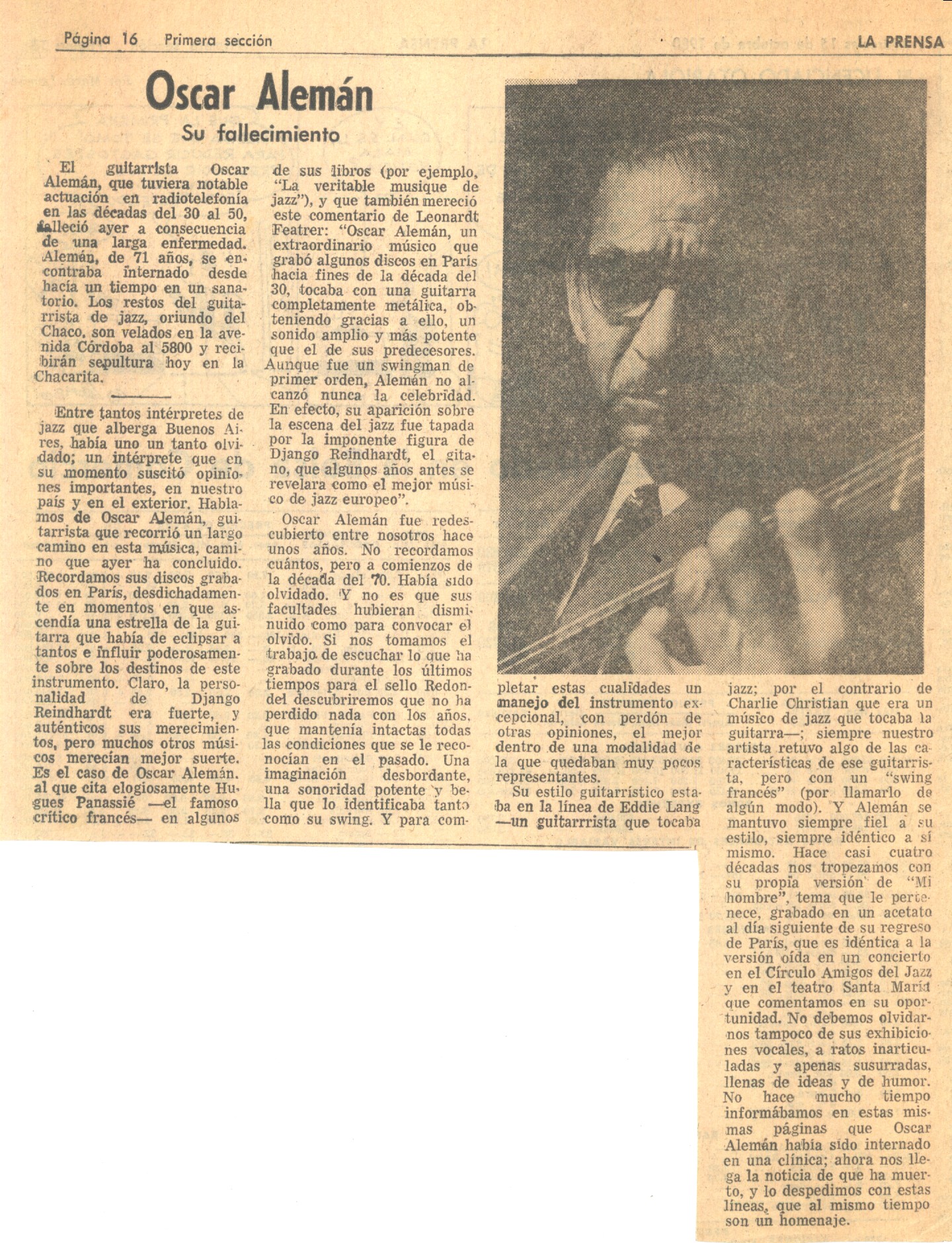
La Prenca - 15th October 1980

Te envio un recorte del diario La Prensa de Buenos Aires del día miercoles 15 de octubre de 1980 con la noticia del fallecimiento de Oscar Aleman.

Cordiales saludos Waldo Fonseca y el Hot Club de Boedo. (Buenos Aires - Argentina )


I love to send a cut to you of the newspaper the La Prensa of Buenos Aires of Wednesday 15th October, 1980 with the news of the death of Oscar Aleman.

Warm greetings of Waldo Fonseca and the Hot Club of Boedo. ( Buenos Aires - Argentine )

Ik stuur je een krantenknipsel uit de La Prensa verschenen in Buenos Aires van 15 oktober 1980 met daarin de aankondiging van het overlijden van Oscar Aleman.

Hartelijke groeten van Waldo Fonseca van de Hot Club de Boedo ( Buenos Aires - Argentinië)

Keep swinging

Hans Koert

keepswinging.blogspot.com

Please visit our daily Keep swinging web log

Friday, March 23, 2007

Les Loups - Tengo Celos & El Mirar de Tus Ojos (1928)

A rare item by Les Loups (Oscar Alemán & Gastón Bueno Lobo), Victor 47014, A: Tengo Celos (Tango) (E. Rietti), B: El Mirar de Tus Ojos (Vals) (A. Russo), recorded Buenos Aires 1928, has just been offered for sale on Ebay. The item has been removed earlier today, sold, I guess.
For more info on the discography of Les Loups, see the online Oscar Alemán discography, click here


Just for fun, I found a video performance of 'Tengo Celos' - WARNING! This is NOT Les Loups!


Jo

Monday, March 05, 2007

El Idolo del Tango

A few weeks ago we could share with you a fragment featuring Oscar Aleman from the 1949 film El Idolo del tango with you. This time another fragment, from the same film, titled Blues Jam.
Enjoy it !


Oscar Aleman: Blues Jam

Thanks to Ton van B. who forwarded this link to Theo.

Keep swinging

Hans Koert

Thursday, February 15, 2007

Oscar Alemán on Screen

Unfortunately not many filmed sequences featuring Oscar Alemán in performance seem to exist. Hernán Gaffet's documentary on Oscar Alemán, 'Una vida con Swing' (2002), has used most of this material available. However, if you haven't viewed Gaffet's documentary, here is an opportunity to watch Oscar playing in a scene from a movie, probably the 'El idolo del Tango' from 1948. I found the following scene on YouTube, enjoy it!


Jo

Friday, January 05, 2007

Discographical Info

Some time ago the Brazilian recordings of Gastón Bueno Lobo were mentioned here to support the fact that he did not commit suicide after the break up of Les Loups in early 1931 as suggested by some sources. In fact, Lobo retuned to Brazil and continued his career as a musician, both as a staff musician at Rádio Mayrink Veiga until the beginning of 1937 and as a recording artist for Columbia in 1932 and for Odeon in 1938 together with Laurindo Almeida, further he participated in a recording for Victor in 1932 on two sides made by an ensemble named Os Namorados da Lua, probably featuring guitaris Rogério Guimãres as leader. According to info in Ary Vasconcelos’ book on Brazilian music Carinhoso etc. (História e Inventário do Choro) (1984) Lobo passed away in 1939, the circumstances untold. Whether he did commit suicide or not, is still an unsolved question, but let us stay with facts here only and leave speculations on Lobo's biographical fate to others. Thus, below I'll add a list of the Brazilian recordings featuring Bueno Lobo.
COLUMBIA:
1932
GASTAO BUENO LOBO ( GUITARRA HAVAIANA ): Gaston Bueno Lobo (hawg), prob. Rogério Guimãres (g)
- 381231 CONFESION – Tango – ( E.S. Discepolo – L.C. Amadori ) - COLUMBIA 22.119-A
- 381231 LA CUMPARSITA – Tango – (G.H.M. Rodrigues – P. Contursi – E. Maroni ) - COLUMBIA 22.119-B
Released Brazil prob. Early or mid 1932
1932
GASTAO BUENO LOBO (GUITARRA): Gaston Bueno Lobo (g), Fernando de Castro Barbosa, voc on 381289
- 381288 NOITE AZUL – Valsa – (Valdo de Abreu – Gastao Bueno Lobo) - COLUMBIA 22.140-A
- 381289 MACIO – Choro – (Gastao Bueno Lobo) - COLUMBIA 22.140-B
Released Brazil July 1932
1932
GASTAO BUENO LOBO (GUITARRA): Gaston Bueno Lobo (g), Moacir Bueno Rocha (voc)
- 381321 OLHOS PASSIONAIS – Fox-Cancao – (Gastao Bueno Lobo - De Chocolat) - COLUMBIA 22.162-A
- 381322 A ABELHA E A FLOR - Valsa – (Guilherme Pereira – Orestes Barbosa) - COLUMBIA 22.162-B
Released Brazil December 1932
1932
GASTAO BUENO LOBO (GUITARRA): Gaston Bueno Lobo (g)
- 381366 SONHO QUE PASSOU – Valsa – (Gastao Bueno Lobo – Jaci Pereira) - COLUMBIA 22.170-A
- 381367 LUIZINHA – Choro – (Henrique Vogeler) - COLUMBIA 22.170-B
Released Brazil December 1932
VICTOR:
1932
OS NAMORADOS DA LUA, prob. GB Lobo hawg, unknown g, b, man, rec. 09/04/1932
- mx ? LÁBÍOS RUBROS - choro - (Aldo Taranto) - VICTOR 33549-A
- mx ? PAMPEIA - toada - (Gastão Lobo - Rogério Guimarães) - VICTOR 33549-B
Released Brazil May 1932
ODEON:
1938
GASTAO BUENO LOBO ( GUITARRA HAVAIANA ): Gaston Bueno Lobo (hawg), Laurindo Almeida (g), Tute (g) Rec. 20/05/1938
- 5844 INSPIRACAO – Choro – ( Laurindo de Almeida ) - ODEON 11649-B
Released Brazil Oct. 1938.
NB!
- 5843 SAUDADE QUE PASSA - choro - ( Laurindo de Almeida ) - ODEON 11649-A
has same personnel, but from audial evidence GB Lobo is not featured on hawg, Laurindo Almeida is mentioned as both interpreter and composer.
---
The above recordings are so far the known Brazilian sides featuring Gastón Bueno Lobo, info on the COLUMBIA and ODEON recordings supplied from the Funarte online discography
The VICTOR recordings by OS NAMORADOS DA LUA are not registered in the Funarte database, the info above supplied from the discographical notes at the IMS online facility
Jo